September
2024
 |
I
had hoped to find a deck which was interesting enough for me to buy at
the joined convention of the (Austrian) Talon, the (German) Bube Dame
König and the I.P.C.S. in Vienna, lasting from 26 until 29 September.
The two trading sessions brought me 1 small patience deck and in the
auction on Sunday there were 3 decks that I had my eye on, but was
outbid. |

|
|
However,
that little patience deck became the inspiration to show the deck below at
this spot. |
I
bought the patience deck from a Dutch collector, because I thought I didn't have
the joker with my deck. But when I had returned home and checked out the deck,
my memory was proven wrong. Well, not completely, because the joker was in worse
condition that the rest of the courts. So I must have remembered that there was
an issue with the joker and interpreted as missing. Anyway, the patience deck
was made by the Speelkaartenfabriek Nederland (SN) and has a pattern, which is
usually referred to as Fortuna here in the Netherlands. It was in production
between 1915 and 1942 in different versions.
Fortuna is in fact a reference to the title of the most luxurious version of
this pattern. It was printed in chromolithography with some 4 colours more on
the courts and aces than the cheaper versions, which were published as "Amstel",
"Club" and since 1928 also as "Schelde" (same, but with a
linen finish). Another distinguishing feature is a cream coloured background,
only used in the Fortuna version.
Amstel and Club had the same coloured fronts of the courts and aces, but the
Amstel version had backs, printed in 2 colours, and the Club version backs in
only one colour. The used indices are usually Dutch, so mostly H, V, B, but also
a K, V, B deck is known. And of course over the years the indices have grown a
bit too.
The following factory numbers were given:
Fortuna - # 799 (gold corners, sliding box)
Amstel - # 422 (round corners, box), # 433 (gold corners, box) and # 444 (gold
corners, sliding box)
Club - # 855 (round corners, box), # 888 (gold corners, box) and # 899 (gold
corners, sliding box)
The patience deck was published in 1919 as Fortuna # 800 and has embellished
aces with flowers instead of the usual castle aces.
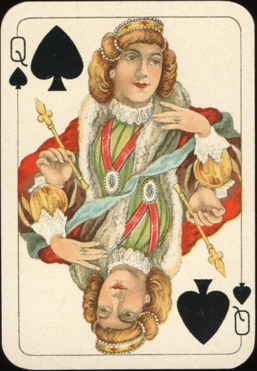
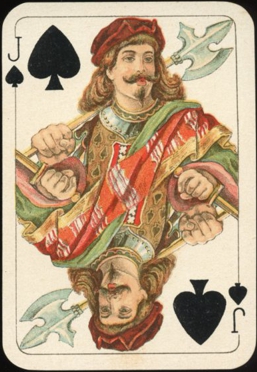
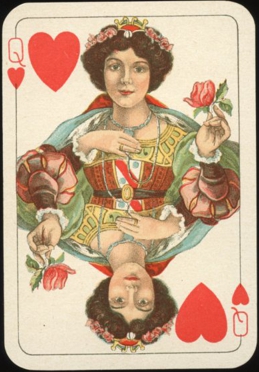
What
makes this deck a bit special is that it has English indices and that the suit
signs are oversized. In Dutch I call them "lobbig", but that was
translated to lobed and by Google as lumpy. Neither is exact, so I've used
oversized. In all the Dutch editions more regular suit signs were used.
There's no cream coloured background and the backs are printed in two colours,
so this is an Amstel version, as in # 444 (not mentioned anywhere, but it has
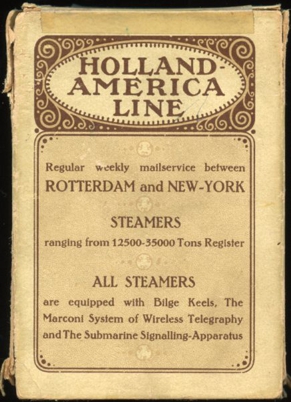
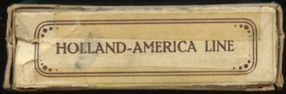
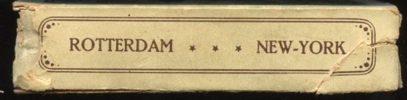
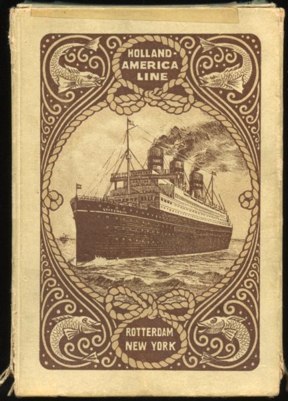
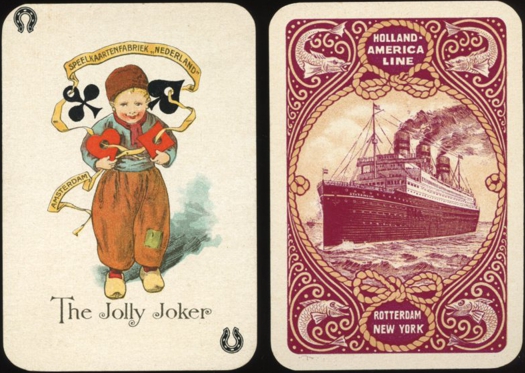
gold corners and comes in a sliding box). The deck was published by the Holland
America Line, as seen on the box and backs. The name of the maker,
Speelkaartenfabriek Nederland, is found on the aces and in this deck also on the
joker, no name on the box nor a logo or name on any of the other courts, which
is done in all the other editions in my collection. Click HERE to see examples of this.
The
backs show the ms Statendam. The H.A.L. has had several cruise ships with that
name since 1898. The first Statendam was in use from 1898 until November 1910,
but had only one steam pipe. The second Statendam was build between 1912 and
1914, but not long after the launch WW I broke out and the finishing work of the
interior was stopped. The ship, already with 3 steam pipes, never made a cruise
for the H.A.L. but was requisitioned by the British government in 1916 to serve
a a transport ship for their troops.
So the depicted ship is probably the third cruise ship of the H.A.L. with this
name. Ordered in 1921, built in Belfast by Harland & Wolff, the same
shipyard that had built Statendam II, in 1922 and
launched in 1924. Further work stopped for 2 years, probably by financial
issues, but when the Dutch government issued a loan to the H.A.L. in 1927, the
ship was towed to Schiedam (NL), where it was finished at the Wilton ship yard.
The maiden voyage to New York was on April 11, 1929. Her last voyage to
Rotterdam left New York on November 24, 1939. During the invasion by the Germans
in May 1940, she was docked in Rotterdam and got caught in crossfire,
which started a fire on board that led to the complete destruction. She was
scrapped in August 1940.
So
the deck was most likely published in 1929, which makes the presence of the
"little farmer" joker with the 2 horse shoes in the corners unusual.
This SN factory joker was in use from around 1913 until around 1925 and the
horse shoes usually indicate an early version. Together with the English indices
and the oversized suit sign, I believe that the deck was specially created for
the H.A.L. and the joker with a typical Dutch farm boy was added to please the
international passengers. And of course to mention the Speelkaartenfabriek
Nederland name more prominently at the same time.
However, there's a slight possibility that the deck was ordered by the H.A.L. in
1914 in anticipation of the maiden voyage of the Statendam II in 1915. The
"Fortuna" pattern was introduced by SN in 1915 and it would fit with
the early little farmer joker.
Enough
text now, time for the pics....
 |
|
|
|
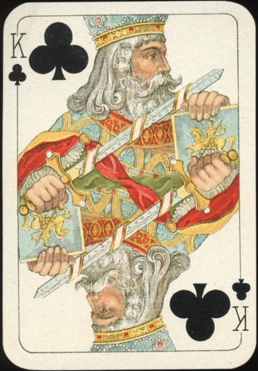
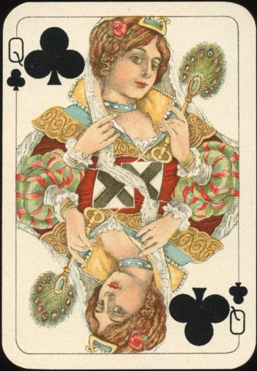
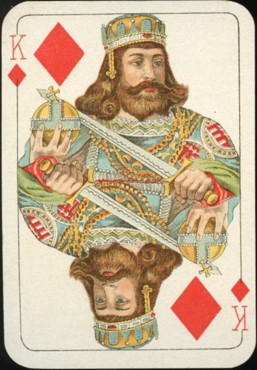
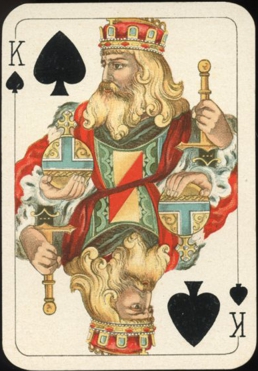
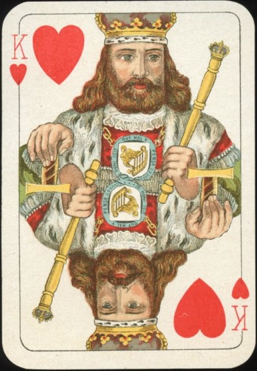
Sorry, a few more lines again first. Some
information about the courts, first described by the makers of the
"Van NSF to SN" catalogue: on the chest of the King of Hearts here
below is the motto of the Order of the Garter "Honi soit qui mal y
pense" surrounding the harp, representing Ireland. The order of the
Garter is the most senior order of knighthood in the United Kingdom.
|
 |
|
|
|
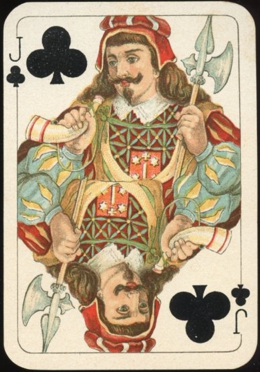
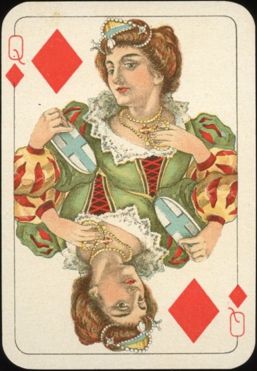
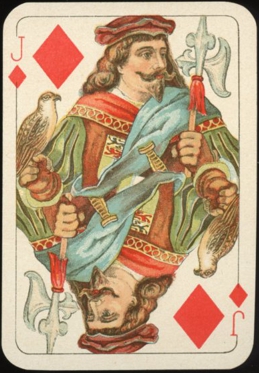
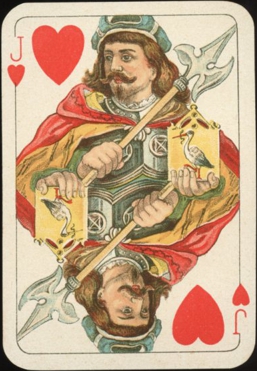
The jacks
represent Dutch cities. They show Dutch city emblems a bit hidden on their
chests, except the jack of Hearts. He boldly show the shield of The Hague.
The jack of Clubs shows 2 of the three crosses from the shield of
Amsterdam. The jack of Clubs shows almost the complete shield of the city
of Haarlem and the jack of Diamonds that of the city of Rotterdam.
|
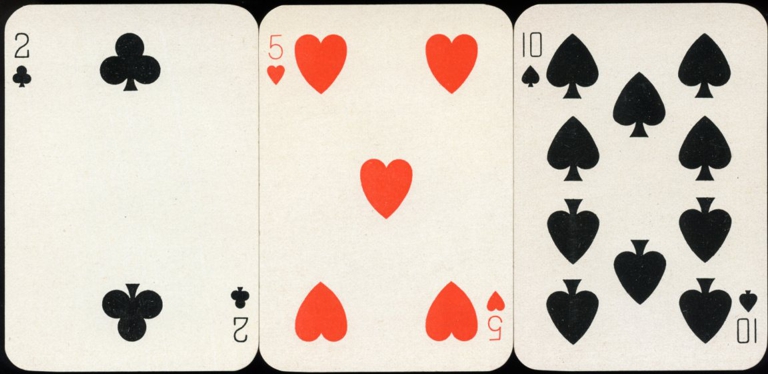
Oversized suit signs on the pip cards too.